Mastering EC Management in Rockwool Cultivation for High-Yield Cannabis Views: 98
In modern hydroponic cannabis production, success is no longer defined only by genetics or lighting systems. One of the most critical—but often underestimated—factors is EC management in the root zone, especially when using rock wool as a growing medium.
Electrical Conductivity (EC) directly determines how nutrients behave in solution, how roots absorb minerals, and how plants respond to irrigation cycles. In rock wool systems, where the substrate is inert and fully dependent on nutrient delivery, EC becomes the central control parameter that defines plant performance.
Understanding how EC interacts with rock wool structure allows growers to precisely manipulate plant growth, improve consistency, and maximize yield potential.

What is EC in Hydroponic Cannabis Cultivation?
EC (Electrical Conductivity) measures the concentration of dissolved salts in a nutrient solution. In cannabis cultivation, these dissolved salts represent essential nutrients such as nitrogen, potassium, calcium, magnesium, and trace elements.
Higher EC means stronger nutrient concentration. Lower EC means weaker nutrient strength.
However, EC is not just a “feeding strength indicator”—it is a dynamic environmental signal that influences:
· Nutrient uptake rate
· Osmotic pressure in roots
· Water absorption efficiency
· Plant transpiration behavior
· Overall metabolic activity
In rock wool systems, EC becomes even more critical because there is no soil buffer to stabilize nutrient fluctuations.
Why Rock Wool Changes the EC Equation
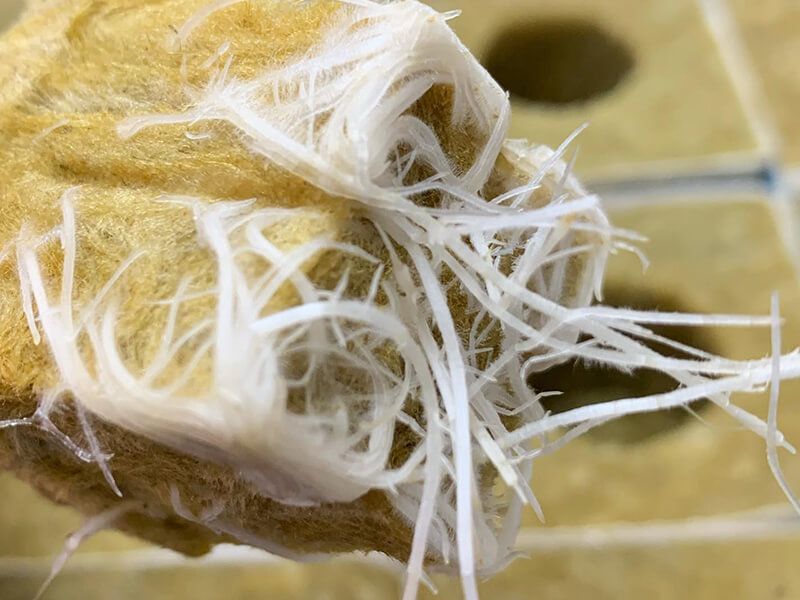
Rock wool is an inert, fibrous substrate made from molten basalt spun into fine mineral fibers. Its structure creates a highly porous environment that holds both water and air in precise proportions.
Unlike soil or coco coir, rock wool does not chemically buffer nutrients. This means:
The EC in the irrigation solution closely reflects the EC in the root zone.
However, the real complexity lies in how EC behaves inside the slab or cube after irrigation.
1. EC Distribution is Driven by Fiber Structure
Rock wool consists of thousands of micro-capillaries. When nutrient solution enters the substrate:
· Water distributes evenly through capillary action
· Salts move with the water phase
· EC becomes spatially uniform across the root zone
This uniformity is one of the biggest advantages of rock wool systems, especially in commercial cannabis production.
2. Dry-Back Cycles Concentrate EC
As plants transpire and water is consumed, rock wool gradually dries between irrigation cycles.
During this process:
· Water leaves the substrate first
· Nutrients remain behind
· EC in the root zone increases naturally
This is known as EC concentration during dry-back.
Growers use this behavior to strategically stress plants (mildly) and influence:
· Compact growth structure
· Increased resin production
· Improved flower density
But excessive dry-back can lead to EC spikes and nutrient burn.
3. Irrigation Events Reset EC Levels
Each irrigation cycle in rock wool serves as a “reset point”:
· Fresh nutrient solution enters
· Excess salts are flushed out
· EC returns to target range
This makes irrigation frequency one of the most powerful EC control tools in hydroponics.
Although values vary depending on cultivar and environment, a general framework is:
· Seedling stage: low EC (gentle nutrient supply)
· Vegetative stage: moderate EC (growth acceleration)
· Flowering stage: higher EC (yield and resin production)
· Final flush: very low EC (salt removal and quality improvement)
The key is not static EC values, but EC stability over time.
EC Imbalance: What Happens When Control Fails?
Too High EC (Salt Stress)
· Leaf tip burn
· Dark, overly thick foliage
· Nutrient lockout (especially calcium/magnesium)
· Reduced water uptake
Too Low EC (Nutrient Deficiency)
· Pale leaves
· Weak stem structure
· Slow growth
· Reduced flower formation
In rock wool systems, these issues can develop quickly due to the absence of buffering capacity.
Why EC Management is More Precise in Rock Wool
Rock wool provides a controlled environment where EC can be monitored and adjusted in real time.
Key advantages include:
· Predictable water retention
· Uniform nutrient distribution
· Fast response to irrigation changes
· Easy leaching of excess salts
· High compatibility with sensor-based automation
This precision is why professional growers rely heavily on rock wool for high-value cannabis production.
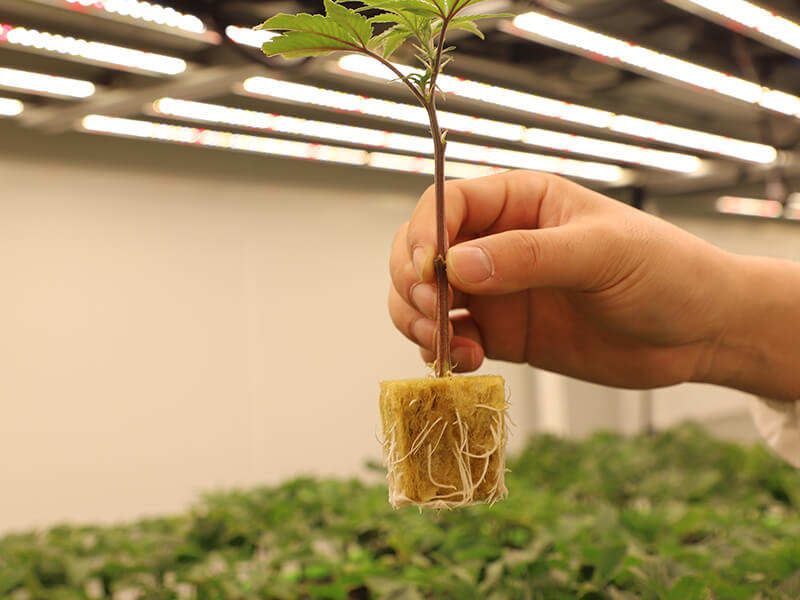
UPuper® rock wool substrates are engineered to support stable and predictable EC management in commercial hydroponic systems.
Their advantages include:
· Uniform fiber density for consistent capillary action
· Stable air-to-water ratio for balanced EC movement
· High drainage efficiency to prevent salt accumulation
· Reliable root-zone structure across production batches
In cannabis cultivation, this translates into:
· More consistent EC readings across slabs
· Reduced risk of localized salt buildup
· Improved irrigation efficiency
· Better crop uniformity at harvest
From propagation cubes to large-scale slabs, UPuper® rock wool systems provide growers with a stable foundation for precision EC control throughout the entire growth cycle.
Best Practices for EC Management in Rock Wool Cannabis Systems
1. Monitor EC Daily
Use drainage EC (runoff EC) as a key indicator of root-zone health.
2. Maintain Controlled Dry-Back
Avoid excessive drying, which can cause EC spikes.
3. Adjust EC by Growth Stage
Do not use a single EC level throughout the cycle.
4. Ensure Proper Drainage
Good drainage prevents salt accumulation in the substrate.
5. Use Automated Irrigation Systems
Pulse irrigation helps stabilize EC fluctuations.
6. Flush Periodically
Prevent long-term salt buildup in rock wool fibers.
Conclusion
EC management is the foundation of successful rock wool-based cannabis cultivation. Because rock wool is an inert and highly responsive medium, nutrient concentration must be carefully controlled to maintain optimal root-zone conditions.
When EC is properly managed, growers can achieve:
· Stronger root systems
· Faster growth rates
· Higher cannabinoid production
· More uniform crop quality
With the support of UPuper® rock wool substrates, commercial growers gain a stable, predictable growing environment that enhances EC control and supports precision-driven hydroponic cannabis production from propagation to harvest.






 Return